Manifold analysis#
The analysis module contains functions for assessing the intrinsic
dimensionality and quality of manifolds.
Note
The format for the user-supplied input data matrix \(\mathbf{X} \in \mathbb{R}^{N \times Q}\), common to all modules, is that \(N\) observations are stored in rows and \(Q\) variables are stored in columns. Since typically \(N \gg Q\), the initial dimensionality of the data set is determined by the number of variables, \(Q\).
The general agreement throughout this documentation is that \(i\) will index observations and \(j\) will index variables.
The representation of the user-supplied data matrix in PCAfold
is the input parameter X, which should be of type numpy.ndarray
and of size (n_observations,n_variables).
Manifold assessment#
This section includes functions for quantitative assessments of manifold dimensionality and for comparing manifold parameterizations according to scales of variation and uniqueness of dependent variable values as introduced in [AAS21] and [AZASP22].
compute_normalized_variance#
- PCAfold.analysis.compute_normalized_variance(indepvars, depvars, depvar_names, npts_bandwidth=25, min_bandwidth=None, max_bandwidth=None, bandwidth_values=None, scale_unit_box=True, n_threads=None, compute_sample_norm_var=False, compute_sample_norm_range=False)#
Compute a normalized variance (and related quantities) for analyzing manifold dimensionality. The normalized variance is computed as
\[\mathcal{N}(\sigma) = \frac{\sum_{i=1}^n (y_i - \mathcal{K}(\hat{x}_i; \sigma))^2}{\sum_{i=1}^n (y_i - \bar{y} )^2}\]where \(\bar{y}\) is the average quantity over the whole manifold and \(\mathcal{K}(\hat{x}_i; \sigma)\) is the weighted average quantity calculated using kernel regression with a Gaussian kernel of bandwidth \(\sigma\) centered around the \(i^{th}\) observation. \(n\) is the number of observations. \(\mathcal{N}(\sigma)\) is computed for each bandwidth in an array of bandwidth values. By default, the
indepvars(\(x\)) are centered and scaled to reside inside a unit box (resulting in \(\hat{x}\)) so that the bandwidths have the same meaning in each dimension. Therefore, the bandwidth and its involved calculations are applied in the normalized independent variable space. This may be turned off by settingscale_unit_boxto False. The bandwidth values may be specified directly throughbandwidth_valuesor default values will be calculated as a logspace frommin_bandwidthtomax_bandwidthwithnpts_bandwidthnumber of values. If left unspecified,min_bandwidthandmax_bandwidthwill be calculated as the minimum and maximum nonzero distance between points, respectively.More information can be found in [AAS21].
Example:
from PCAfold import PCA, compute_normalized_variance
import numpy as np

# Generate dummy data set:
X = np.random.rand(100,5)

# Perform PCA to obtain the low-dimensional manifold:
pca_X = PCA(X, n_components=2)
principal_components = pca_X.transform(X)

# Compute normalized variance quantities:
variance_data = compute_normalized_variance(principal_components, X, depvar_names=['A', 'B', 'C', 'D', 'E'], bandwidth_values=np.logspace(-3, 1, 20), scale_unit_box=True)

# Access bandwidth values:
variance_data.bandwidth_values

# Access normalized variance values:
variance_data.normalized_variance

# Access normalized variance values for a specific variable:
variance_data.normalized_variance['B']
- Parameters
indepvars –
numpy.ndarrayspecifying the independent variable values. It should be of size(n_observations,n_independent_variables).depvars –
numpy.ndarrayspecifying the dependent variable values. It should be of size(n_observations,n_dependent_variables).depvar_names –
listofstrcorresponding to the names of the dependent variables (for saving values in a dictionary)npts_bandwidth – (optional, default 25) number of points to build a logspace of bandwidth values
min_bandwidth – (optional, default to minimum nonzero interpoint distance) minimum bandwidth
max_bandwidth – (optional, default to estimated maximum interpoint distance) maximum bandwidth
bandwidth_values – (optional) array of bandwidth values, i.e. filter widths for a Gaussian filter, to loop over
scale_unit_box – (optional, default True) center/scale the independent variables between [0,1] for computing a normalized variance so the bandwidth values have the same meaning in each dimension
n_threads – (optional, default None) number of threads to run this computation. If None, default behavior of multiprocessing.Pool is used, which is to use all available cores on the current system.
compute_sample_norm_var – (optional, default False)
boolspecifying if sample normalized variance should be computed.compute_sample_norm_range – (optional, default False)
boolspecifying if sample normalized range should be computed.
- Returns
variance_data - an object of the
VarianceDataclass.
Class VarianceData#
- class PCAfold.analysis.VarianceData(bandwidth_values, norm_var, global_var, bandwidth_10pct_rise, keys, norm_var_limit, sample_norm_var, sample_norm_range)#
A class for storing helpful quantities in analyzing dimensionality of manifolds through normalized variance measures. This class will be returned by
compute_normalized_variance.- Parameters
bandwidth_values – the array of bandwidth values (Gaussian filter widths) used in computing the normalized variance for each variable
normalized_variance – dictionary of the normalized variance computed at each of the bandwidth values for each variable
global_variance – dictionary of the global variance for each variable
bandwidth_10pct_rise – dictionary of the bandwidth value corresponding to a 10% rise in the normalized variance for each variable
variable_names – list of the variable names
normalized_variance_limit – dictionary of the normalized variance computed as the bandwidth approaches zero (numerically at \(10^{-16}\)) for each variable
sample_normalized_variance – dictionary of the sample normalized variance for every observation, for each bandwidth and for each variable
normalized_variance_derivative#
- PCAfold.analysis.normalized_variance_derivative(variance_data)#
Compute a scaled normalized variance derivative on a logarithmic scale, \(\hat{\mathcal{D}}(\sigma)\), from
\[\mathcal{D}(\sigma) = \frac{\mathrm{d}\mathcal{N}(\sigma)}{\mathrm{d}\log_{10}(\sigma)} + \lim_{\sigma \to 0} \mathcal{N}(\sigma)\]and
\[\hat{\mathcal{D}}(\sigma) = \frac{\mathcal{D}(\sigma)}{\max(\mathcal{D}(\sigma))}\]This value relays how fast the variance is changing as the bandwidth changes and captures non-uniqueness from nonzero values of \(\lim_{\sigma \to 0} \mathcal{N}(\sigma)\). The derivative is approximated with central finite differencing and the limit is approximated by \(\mathcal{N}(\sigma=10^{-16})\) using the
normalized_variance_limitattribute of theVarianceDataobject.More information can be found in [AAS21].
Example:
from PCAfold import PCA, compute_normalized_variance, normalized_variance_derivative
import numpy as np

# Generate dummy data set:
X = np.random.rand(100,5)

# Perform PCA to obtain the low-dimensional manifold:
pca_X = PCA(X, n_components=2)
principal_components = pca_X.transform(X)

# Compute normalized variance quantities:
variance_data = compute_normalized_variance(principal_components, X, depvar_names=['A', 'B', 'C', 'D', 'E'], bandwidth_values=np.logspace(-3, 1, 20), scale_unit_box=True)

# Compute normalized variance derivative:
(derivative, bandwidth_values, max_derivative) = normalized_variance_derivative(variance_data)

# Access normalized variance derivative values for a specific variable:
derivative['B']
- Parameters
variance_data – a
VarianceDataclass returned fromcompute_normalized_variance- Returns
derivative_dict - a dictionary of \(\hat{\mathcal{D}}(\sigma)\) for each variable in the provided
VarianceDataobjectx - the \(\sigma\) values where \(\hat{\mathcal{D}}(\sigma)\) was computed
max_derivatives_dicts - a dictionary of \(\max(\mathcal{D}(\sigma))\) values for each variable in the provided
VarianceDataobject.
find_local_maxima#
- PCAfold.analysis.find_local_maxima(dependent_values, independent_values, logscaling=True, threshold=0.01, show_plot=False)#
Finds and returns locations and values of local maxima in a dependent variable given a set of observations. The functional form of the dependent variable is approximated with a cubic spline for smoother approximations to local maxima.
- Parameters
dependent_values – observations of a single dependent variable such as \(\hat{\mathcal{D}}\) from
normalized_variance_derivative(for a single variable).independent_values – observations of a single independent variable such as \(\sigma\) returned by
normalized_variance_derivativelogscaling – (optional, default True) this logarithmically scales
independent_valuesbefore finding local maxima. This is needed for scaling \(\sigma\) appropriately before finding peaks in \(\hat{\mathcal{D}}\).threshold – (optional, default \(10^{-2}\)) local maxima found below this threshold will be ignored.
show_plot – (optional, default False) when True, a plot of the
dependent_valuesoverindependent_values(logarithmically scaled iflogscalingis True) with the local maxima highlighted will be shown.
- Returns
the locations of local maxima in
dependent_valuesthe local maxima values
random_sampling_normalized_variance#
- PCAfold.analysis.random_sampling_normalized_variance(sampling_percentages, indepvars, depvars, depvar_names, n_sample_iterations=1, verbose=True, npts_bandwidth=25, min_bandwidth=None, max_bandwidth=None, bandwidth_values=None, scale_unit_box=True, n_threads=None)#
Compute the normalized variance derivatives \(\hat{\mathcal{D}}(\sigma)\) for random samples of the provided data specified using
sampling_percentages. These will be averaged overn_sample_iterationsiterations. Analyzing the shift in peaks of \(\hat{\mathcal{D}}(\sigma)\) due to sampling can distinguish between characteristic features and non-uniqueness due to a transformation/reduction of manifold coordinates. True features should not show significant sensitivity to sampling while non-uniqueness/folds in the manifold will.More information can be found in [AAS21].
- Parameters
sampling_percentages – list or 1D array of fractions (between 0 and 1) of the provided data to sample for computing the normalized variance
indepvars – independent variable values (size: n_observations x n_independent variables)
depvars – dependent variable values (size: n_observations x n_dependent variables)
depvar_names – list of strings corresponding to the names of the dependent variables (for saving values in a dictionary)
n_sample_iterations – (optional, default 1) how many iterations for each
sampling_percentagesto average the normalized variance derivative oververbose – (optional, default True) when True, progress statements are printed
npts_bandwidth – (optional, default 25) number of points to build a logspace of bandwidth values
min_bandwidth – (optional, default to minimum nonzero interpoint distance) minimum bandwidth
max_bandwidth – (optional, default to estimated maximum interpoint distance) maximum bandwidth
bandwidth_values – (optional) array of bandwidth values, i.e. filter widths for a Gaussian filter, to loop over
scale_unit_box – (optional, default True) center/scale the independent variables between [0,1] for computing a normalized variance so the bandwidth values have the same meaning in each dimension
n_threads – (optional, default None) number of threads to run this computation. If None, default behavior of multiprocessing.Pool is used, which is to use all available cores on the current system.
- Returns
a dictionary of the normalized variance derivative (\(\hat{\mathcal{D}}(\sigma)\)) for each sampling percentage in
sampling_percentagesaveraged overn_sample_iterationsiterationsthe \(\sigma\) values used for computing \(\hat{\mathcal{D}}(\sigma)\)
a dictionary of the
VarianceDataobjects for each sampling percentage and iteration insampling_percentagesandn_sample_iterations
feature_size_map#
- PCAfold.analysis.feature_size_map(variance_data, variable_name, cutoff=1, starting_bandwidth_idx='peak', use_variance=False, verbose=False)#
Computes a map of local feature sizes on a manifold.
Example:
from PCAfold import PCA, compute_normalized_variance, feature_size_map
import numpy as np

# Generate dummy data set:
X = np.random.rand(100,10)

# Specify variables names
variable_names = ['X_' + str(i) for i in range(0,10)]

# Perform PCA to obtain the low-dimensional manifold:
pca_X = PCA(X, n_components=2)
principal_components = pca_X.transform(X)

# Specify the bandwidth values:
bandwidth_values = np.logspace(-4, 2, 50)

# Compute normalized variance quantities:
variance_data = compute_normalized_variance(principal_components,
                                            X,
                                            depvar_names=variable_names,
                                            bandwidth_values=bandwidth_values)

# Compute the feature size map:
feature_size_map = feature_size_map(variance_data,
                                    variable_name='X_1',
                                    cutoff=1,
                                    starting_bandwidth_idx='peak',
                                    verbose=True)
- Parameters
variance_data – an object of
VarianceDataclass.variable_name –
strspecifying the name of the dependent variable for which the feature size map should be computed. It should be as per name specified when computingvariance_data.cutoff – (optional)
floatorintspecifying the cutoff percentage, \(p\). It should be a number between 0 and 100.starting_bandwidth_idx – (optional)
intorstrspecifying the index of the starting bandwidth to compute the local feature sizes from. Local feature sizes computed will never be smaller than the starting bandwidth. If set to'peak', the starting bandwidth will be automatically calculated as the rightmost peak, \(\sigma_{peak}\).verbose – (optional)
boolfor printing verbose details.
- Returns
feature_size_map -
numpy.ndarrayspecifying the local feature sizes on a manifold, \(\mathbf{B}\). It has size(n_observations,).
feature_size_map_smooth#
- PCAfold.analysis.feature_size_map_smooth(indepvars, feature_size_map, method='median', n_neighbors=10)#
Smooths out a map of local feature sizes on a manifold.
Note
This function requires the
scikit-learnmodule. You can install it through:pip install scikit-learnExample:
from PCAfold import PCA, compute_normalized_variance, feature_size_map, smooth_feature_size_map
import numpy as np

# Generate dummy data set:
X = np.random.rand(100,10)

# Specify variables names
variable_names = ['X_' + str(i) for i in range(0,10)]

# Perform PCA to obtain the low-dimensional manifold:
pca_X = PCA(X, n_components=2)
principal_components = pca_X.transform(X)

# Specify the bandwidth values:
bandwidth_values = np.logspace(-4, 2, 50)

# Compute normalized variance quantities:
variance_data = compute_normalized_variance(principal_components,
                                            X,
                                            depvar_names=variable_names,
                                            bandwidth_values=bandwidth_values)

# Compute the feature size map:
feature_size_map = feature_size_map(variance_data,
                                    variable_name='X_1',
                                    cutoff=1,
                                    starting_bandwidth_idx='peak',
                                    verbose=True)

# Smooth out the feature size map:
updated_feature_size_map = feature_size_map_smooth(principal_components,
                                                   feature_size_map,
                                                   method='median',
                                                   n_neighbors=4)
- Parameters
indepvars –
numpy.ndarrayspecifying the independent variable values. It should be of size(n_observations,n_independent_variables).feature_size_map –
numpy.ndarrayspecifying the local feature sizes on a manifold, \(\mathbf{B}\). It should be of size(n_observations,)or(n_observations,1).method – (optional)
strspecifying the smoothing method. It can be'median','mean','max'or'min'.n_neighbors – (optional)
intspecifying the number of nearest neighbors to smooth over.
- Returns
updated_feature_size_map -
numpy.ndarrayspecifying the smoothed local feature sizes on a manifold, \(\mathbf{B}\). It has size(n_observations,).
cost_function_normalized_variance_derivative#
- PCAfold.analysis.cost_function_normalized_variance_derivative(variance_data, penalty_function=None, power=1, vertical_shift=1, norm=None, integrate_to_peak=False, rightmost_peak_shift=None)#
Defines a cost function for manifold topology assessment based on the areas, or weighted (penalized) areas, under the normalized variance derivatives curves, \(\hat{\mathcal{D}}(\sigma)\), for the selected \(n_{dep}\) dependent variables.
More information on the theory and application of the cost function can be found in [AZASP22].
An individual area, \(A_i\), for the \(i^{th}\) dependent variable, is computed by directly integrating the function \(\hat{\mathcal{D}}_i(\sigma)\) in the \(\log_{10}\) space of bandwidths \(\sigma\). Integration is performed using the composite trapezoid rule.
When
integrate_to_peak=False, the bounds of integration go from the minimum bandwidth, \(\sigma_{min, i}\), to the maximum bandwidth, \(\sigma_{max, i}\):\[A_i = \int_{\sigma_{min, i}}^{\sigma_{max, i}} \hat{\mathcal{D}}_i(\sigma) d \log_{10} \sigma\]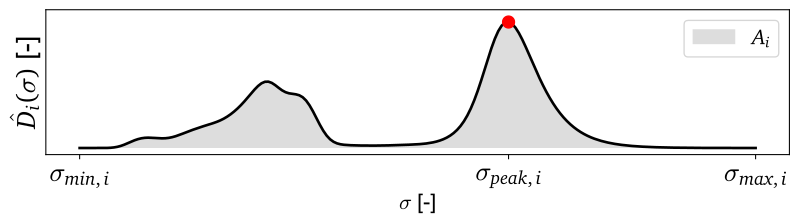
When
integrate_to_peak=True, the bounds of integration go from the minimum bandwidth, \(\sigma_{min, i}\), to the bandwidth for which the rightmost peak happens in \(\hat{\mathcal{D}}_i(\sigma)\), \(\sigma_{peak, i}\):\[A_i = \int_{\sigma_{min, i}}^{\sigma_{peak, i}} \hat{\mathcal{D}}_i(\sigma) d \log_{10} \sigma\]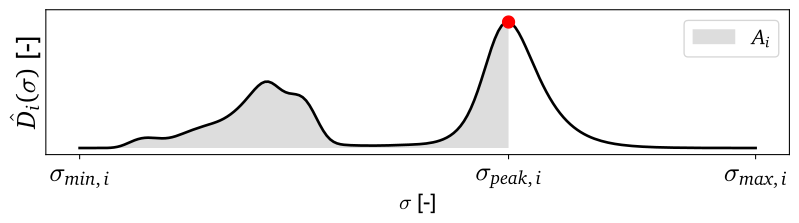
In addition, each individual area, \(A_i\), can be weighted. The following weighting options are available:
If
penalty_function='peak', \(A_i\) is weighted by the inverse of the rightmost peak location:
\[A_i = \frac{1}{\sigma_{peak, i}} \cdot \int \hat{\mathcal{D}}_i(\sigma) d(\log_{10} \sigma)\]This creates a constant penalty:
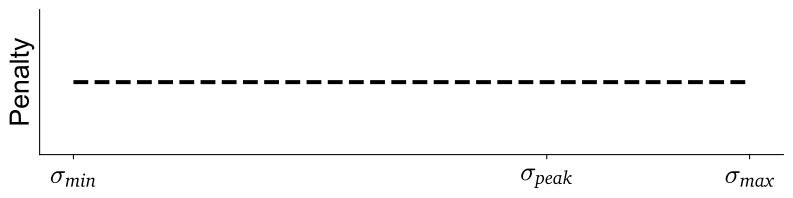
If
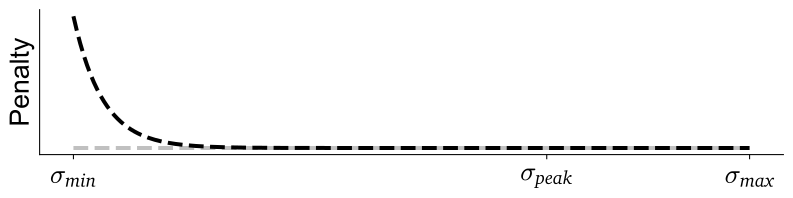
penalty_function='sigma', \(A_i\) is weighted continuously by the bandwidth:
\[A_i = \int \frac{1}{\sigma^r} \cdot \hat{\mathcal{D}}_i(\sigma) d(\log_{10} \sigma)\]where \(r\) is a hyper-parameter that can be controlled by the user. This type of weighting strongly penalizes the area happening at lower bandwidth values.
For instance, when \(r=0.2\):
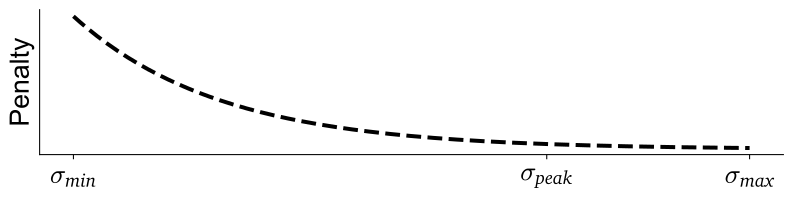
When \(r=1\) (with the penalty corresponding to \(r=0.2\) plotted in gray in the background):
If
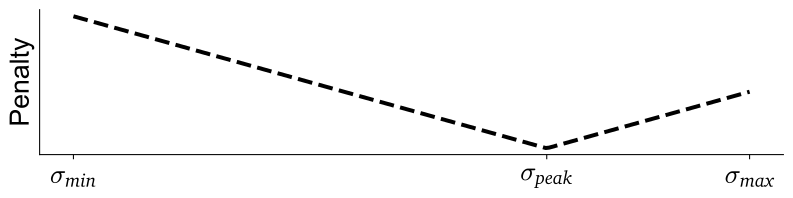
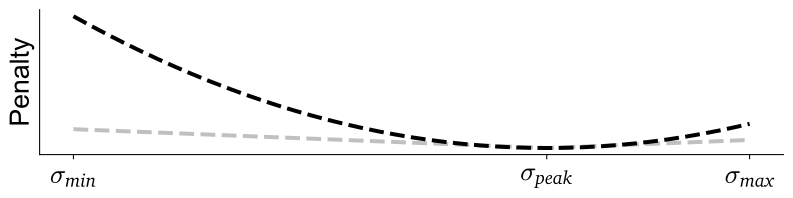
penalty_function='log-sigma-over-peak', \(A_i\) is weighted continuously by the \(\log_{10}\) -transformed bandwidth and takes into account information about the rightmost peak location.
\[A_i = \int \Big( \big| \log_{10} \Big( \frac{\sigma}{\sigma_{peak, i}} \Big) \big|^r + b \cdot \frac{\log_{10} \sigma_{max, i} - \log_{10} \sigma_{min, i}}{\log_{10} \sigma_{peak, i} - \log_{10} \sigma_{min, i}} \Big) \cdot \hat{\mathcal{D}}_i(\sigma) d(\log_{10} \sigma)\]This type of weighting creates a more gentle penalty for the area happening further from the rightmost peak location. By increasing \(b\), the user can increase the amount of penalty applied to smaller feature sizes over larger ones. By increasing \(r\), the user can penalize non-uniqueness more strongly.
For instance, when \(r=1\):
When \(r=2\) (with the penalty corresponding to \(r=1\) plotted in gray in the background):
If
norm=None, a list of costs for all dependent variables is returned. Otherwise, the final cost, \(\mathcal{L}\), can be computed from all \(A_i\) in a few ways, where \(n_{dep}\) is the number of dependent variables stored in thevariance_dataobject:If
norm='average', \(\mathcal{L} = \frac{1}{n_{dep}} \sum_{i = 1}^{n_{dep}} A_i\).If
norm='cumulative', \(\mathcal{L} = \sum_{i = 1}^{n_{dep}} A_i\).If
norm='max', \(\mathcal{L} = \text{max} (A_i)\).If
norm='median', \(\mathcal{L} = \text{median} (A_i)\).If
norm='min', \(\mathcal{L} = \text{min} (A_i)\).
Example:
from PCAfold import PCA, compute_normalized_variance, cost_function_normalized_variance_derivative
import numpy as np

# Generate dummy data set:
X = np.random.rand(100,10)

# Specify variables names
variable_names = ['X_' + str(i) for i in range(0,10)]

# Perform PCA to obtain the low-dimensional manifold:
pca_X = PCA(X, n_components=2)
principal_components = pca_X.transform(X)

# Specify the bandwidth values:
bandwidth_values = np.logspace(-4, 2, 50)

# Compute normalized variance quantities:
variance_data = compute_normalized_variance(principal_components,
                                            X,
                                            depvar_names=variable_names,
                                            bandwidth_values=bandwidth_values)

# Compute the cost for the current manifold:
cost = cost_function_normalized_variance_derivative(variance_data,
                                                    penalty_function='sigma',
                                                    power=0.5,
                                                    vertical_shift=1,
                                                    norm='max',
                                                    integrate_to_peak=True)
- Parameters
variance_data – an object of
VarianceDataclass.penalty_function – (optional)
strspecifying the weighting (penalty) applied to each area. Setpenalty_function='peak'to weight each area by the rightmost peak location, \(\sigma_{peak, i}\), for the \(i^{th}\) dependent variable. Setpenalty_function='sigma'to weight each area continuously by the bandwidth. Setpenalty_function='log-sigma'to weight each area continuously by the \(\log_{10}\) -transformed bandwidth. Setpenalty_function='log-sigma-over-peak'to weight each area continuously by the \(\log_{10}\) -transformed bandwidth, normalized by the right most peak location, \(\sigma_{peak, i}\). Ifpenalty_function=None, the area is not weighted.power – (optional)
floatorintspecifying the power, \(r\). It can be used to control how much penalty should be applied to variance happening at the smallest length scales.vertical_shift – (optional)
floatorintspecifying the vertical shift multiplier, \(b\). It can be used to control how much penalty should be applied to feature sizes.norm – (optional)
strspecifying the norm to apply for all areas \(A_i\).norm='average'uses an arithmetic average,norm='max'uses the \(L_{\infty}\) norm,norm='median'uses a median area,norm='cumulative'uses a cumulative area andnorm='min'uses a minimum area. Ifnorm=None, a list of costs for all depedent variables is returned.integrate_to_peak – (optional)
boolspecifying whether an individual area for the \(i^{th}\) dependent variable should be computed only up the the rightmost peak location.rightmost_peak_shift – (optional)
floatorintspecifying the percentage, \(p\), of shift in the rightmost peak location. If set to a number between 0 and 100, a quantity \(p/100 (\sigma_{max} - \sigma_{peak, i})\) is added to the rightmost peak location. It can be used to move the rightmost peak location further right, for instance if there is a blending of scales in the \(\hat{\mathcal{D}}(\sigma)\) profile.
- Returns
cost -
floatspecifying the normalized cost, \(\mathcal{L}\), or, ifnorm=None, a list of costs, \(A_i\), for each dependent variable.
Kernel Regression#
This section includes details on the Nadaraya-Watson kernel regression
[AHardle90] used in assessing manifolds. The KReg class may be used
for non-parametric regression in general.
Class KReg#
- class PCAfold.kernel_regression.KReg(indepvars, depvars, internal_dtype=<class 'float'>, supress_warning=False)#
A class for building and evaluating Nadaraya-Watson kernel regression models using a Gaussian kernel. The regression estimator \(\mathcal{K}(u; \sigma)\) evaluated at independent variables \(u\) can be expressed using a set of \(n\) observations of independent variables (\(x\)) and dependent variables (\(y\)) as follows
\[\mathcal{K}(u; \sigma) = \frac{\sum_{i=1}^{n} \mathcal{W}_i(u; \sigma) y_i}{\sum_{i=1}^{n} \mathcal{W}_i(u; \sigma)}\]where a Gaussian kernel of bandwidth \(\sigma\) is used as
\[\mathcal{W}_i(u; \sigma) = \exp \left( \frac{-|| x_i - u ||_2^2}{\sigma^2} \right)\]Both constant and variable bandwidths are supported. Kernels with anisotropic bandwidths are calculated as
\[\mathcal{W}_i(u; \sigma) = \exp \left( -|| \text{diag}(\sigma)^{-1} (x_i - u) ||_2^2 \right)\]where \(\sigma\) is a vector of bandwidths per independent variable.
Example:
from PCAfold import KReg
import numpy as np

indepvars = np.expand_dims(np.linspace(0,np.pi,11),axis=1)
depvars = np.cos(indepvars)
query = np.expand_dims(np.linspace(0,np.pi,21),axis=1)

model = KReg(indepvars, depvars)
predicted = model.predict(query, 'nearest_neighbors_isotropic', n_neighbors=1)
- Parameters
indepvars –
numpy.ndarrayspecifying the independent variable training data, \(x\) in equations above. It should be of size(n_observations,n_independent_variables).depvars –
numpy.ndarrayspecifying the dependent variable training data, \(y\) in equations above. It should be of size(n_observations,n_dependent_variables).internal_dtype – (optional, default float) data type to enforce in training and evaluating
supress_warning – (optional, default False) if True, turns off printed warnings
KReg.predict#
- PCAfold.kernel_regression.KReg.predict(self, query_points, bandwidth, n_neighbors=None)#
Calculate dependent variable predictions at
query_points.- Parameters
query_points –
numpy.ndarrayspecifying the independent variable points to query the model. It should be of size(n_points,n_independent_variables).bandwidth –
value(s) to use for the bandwidth in the Gaussian kernel. Supported formats include:
single value: constant bandwidth applied to each query point and independent variable dimension.
2D array shape (n_points x n_independent_variables): an array of bandwidths for each independent variable dimension of each query point.
string “nearest_neighbors_isotropic”: This option requires the argument
n_neighborsto be specified for which a bandwidth will be calculated for each query point based on the Euclidean distance to then_neighborsnearestindepvarspoint.string “nearest_neighbors_anisotropic”: This option requires the argument
n_neighborsto be specified for which a bandwidth will be calculated for each query point based on the distance in each (separate) independent variable dimension to then_neighborsnearestindepvarspoint.
- Returns
dependent variable predictions for the
query_points
KReg.compute_constant_bandwidth#
- PCAfold.kernel_regression.KReg.compute_constant_bandwidth(self, query_points, bandwidth)#
Format a single bandwidth value into a 2D array matching the shape of
query_points- Parameters
query_points – array of independent variable points to query the model (n_points x n_independent_variables)
bandwidth – single value for the bandwidth used in a Gaussian kernel
- Returns
an array of bandwidth values matching the shape of
query_points
KReg.compute_bandwidth_isotropic#
- PCAfold.kernel_regression.KReg.compute_bandwidth_isotropic(self, query_points, bandwidth)#
Format a 1D array of bandwidth values for each point in
query_pointsinto a 2D array matching the shape ofquery_points- Parameters
query_points – array of independent variable points to query the model (n_points x n_independent_variables)
bandwidth – 1D array of bandwidth values length n_points
- Returns
an array of bandwidth values matching the shape of
query_points(repeats the bandwidth array for each independent variable)
KReg.compute_bandwidth_anisotropic#
- PCAfold.kernel_regression.KReg.compute_bandwidth_anisotropic(self, query_points, bandwidth)#
Format a 1D array of bandwidth values for each independent variable into the 2D array matching the shape of
query_points- Parameters
query_points – array of independent variable points to query the model (n_points x n_independent_variables)
bandwidth – 1D array of bandwidth values length n_independent_variables
- Returns
an array of bandwidth values matching the shape of
query_points(repeats the bandwidth array for each point inquery_points)
KReg.compute_nearest_neighbors_bandwidth_isotropic#
- PCAfold.kernel_regression.KReg.compute_nearest_neighbors_bandwidth_isotropic(self, query_points, n_neighbors)#
Compute a variable bandwidth for each point in
query_pointsbased on the Euclidean distance to then_neighborsnearest neighbor- Parameters
query_points – array of independent variable points to query the model (n_points x n_independent_variables)
n_neighbors – integer value for the number of nearest neighbors to consider in computing a bandwidth (distance)
- Returns
an array of bandwidth values matching the shape of
query_points(varies for each point, constant across independent variables)
KReg.compute_nearest_neighbors_bandwidth_anisotropic#
- PCAfold.kernel_regression.KReg.compute_nearest_neighbors_bandwidth_anisotropic(self, query_points, n_neighbors)#
Compute a variable bandwidth for each point in
query_pointsand each independent variable separately based on the distance to then_neighborsnearest neighbor in each independent variable dimension- Parameters
query_points – array of independent variable points to query the model (n_points x n_independent_variables)
n_neighbors – integer value for the number of nearest neighbors to consider in computing a bandwidth (distance)
- Returns
an array of bandwidth values matching the shape of
query_points(varies for each point and independent variable)
Plotting functions#
plot_normalized_variance#
- PCAfold.analysis.plot_normalized_variance(variance_data, plot_variables=[], color_map='Blues', figure_size=(10, 5), title=None, save_filename=None)#
This function plots normalized variance \(\mathcal{N}(\sigma)\) over bandwith values \(\sigma\) from an object of a
VarianceDataclass.Note: this function can accomodate plotting up to 18 variables at once. You can specify which variables should be plotted using
plot_variableslist.Example:
from PCAfold import PCA, compute_normalized_variance, plot_normalized_variance
import numpy as np

# Generate dummy data set:
X = np.random.rand(100,5)

# Perform PCA to obtain the low-dimensional manifold:
pca_X = PCA(X, n_components=2)
principal_components = pca_X.transform(X)

# Compute normalized variance quantities:
variance_data = compute_normalized_variance(principal_components, X, depvar_names=['A', 'B', 'C', 'D', 'E'], bandwidth_values=np.logspace(-3, 1, 20), scale_unit_box=True)

# Plot normalized variance quantities:
plt = plot_normalized_variance(variance_data,
                               plot_variables=[0,1,2],
                               color_map='Blues',
                               figure_size=(10,5),
                               title='Normalized variance',
                               save_filename='N.pdf')
plt.close()
- Parameters
variance_data – an object of
VarianceDataclass objects whose normalized variance quantities should be plotted.plot_variables – (optional)
listofintspecifying indices of variables to be plotted. By default, all variables are plotted.color_map – (optional)
strormatplotlib.colors.ListedColormapspecifying the colormap to use as permatplotlib.cm. Default is'Blues'.figure_size – (optional)
tuplespecifying figure size.title – (optional)
strspecifying plot title. If set toNonetitle will not be plotted.save_filename – (optional)
strspecifying plot save location/filename. If set toNoneplot will not be saved. You can also set a desired file extension, for instance.pdf. If the file extension is not specified, the default is.png.
- Returns
plt -
matplotlib.pyplotplot handle.
plot_normalized_variance_comparison#
- PCAfold.analysis.plot_normalized_variance_comparison(variance_data_tuple, plot_variables_tuple, color_map_tuple, figure_size=(10, 5), title=None, save_filename=None)#
This function plots a comparison of normalized variance \(\mathcal{N}(\sigma)\) over bandwith values \(\sigma\) from several objects of a
VarianceDataclass.Note: this function can accomodate plotting up to 18 variables at once. You can specify which variables should be plotted using
plot_variableslist.Example:
from PCAfold import PCA, compute_normalized_variance, plot_normalized_variance_comparison
import numpy as np

# Generate dummy data sets:
X = np.random.rand(100,5)
Y = np.random.rand(100,5)

# Perform PCA to obtain low-dimensional manifolds:
pca_X = PCA(X, n_components=2)
pca_Y = PCA(Y, n_components=2)
principal_components_X = pca_X.transform(X)
principal_components_Y = pca_Y.transform(Y)

# Compute normalized variance quantities:
variance_data_X = compute_normalized_variance(principal_components_X, X, depvar_names=['A', 'B', 'C', 'D', 'E'], bandwidth_values=np.logspace(-3, 2, 20), scale_unit_box=True)
variance_data_Y = compute_normalized_variance(principal_components_Y, Y, depvar_names=['F', 'G', 'H', 'I', 'J'], bandwidth_values=np.logspace(-3, 2, 20), scale_unit_box=True)

# Plot a comparison of normalized variance quantities:
plt = plot_normalized_variance_comparison((variance_data_X, variance_data_Y),
                                          ([0,1,2], [0,1,2]),
                                          ('Blues', 'Reds'),
                                          figure_size=(10,5),
                                          title='Normalized variance comparison',
                                          save_filename='N.pdf')
plt.close()
- Parameters
variance_data_tuple –
tupleofVarianceDataclass objects whose normalized variance quantities should be compared on one plot. For instance:(variance_data_1, variance_data_2).plot_variables_tuple –
listofintspecifying indices of variables to be plotted. It should have as many elements as there areVarianceDataclass objects supplied. For instance:([], [])will plot all variables.color_map – (optional)
tupleofstrormatplotlib.colors.ListedColormapspecifying the colormap to use as permatplotlib.cm. It should have as many elements as there areVarianceDataclass objects supplied. For instance:('Blues', 'Reds').figure_size – (optional)
tuplespecifying figure size.title – (optional)
strspecifying plot title. If set toNonetitle will not be plotted.save_filename – (optional)
strspecifying plot save location/filename. If set toNoneplot will not be saved. You can also set a desired file extension, for instance.pdf. If the file extension is not specified, the default is.png.
- Returns
plt -
matplotlib.pyplotplot handle.
plot_normalized_variance_derivative#
- PCAfold.analysis.plot_normalized_variance_derivative(variance_data, plot_variables=[], color_map='Blues', figure_size=(10, 5), title=None, save_filename=None)#
This function plots a scaled normalized variance derivative (computed over logarithmically scaled bandwidths), \(\hat{\mathcal{D}(\sigma)}\), over bandwith values \(\sigma\) from an object of a
VarianceDataclass.Note: this function can accomodate plotting up to 18 variables at once. You can specify which variables should be plotted using
plot_variableslist.Example:
from PCAfold import PCA, compute_normalized_variance, plot_normalized_variance_derivative
import numpy as np

# Generate dummy data set:
X = np.random.rand(100,5)

# Perform PCA to obtain the low-dimensional manifold:
pca_X = PCA(X, n_components=2)
principal_components = pca_X.transform(X)

# Compute normalized variance quantities:
variance_data = compute_normalized_variance(principal_components, X, depvar_names=['A', 'B', 'C', 'D', 'E'], bandwidth_values=np.logspace(-3, 1, 20), scale_unit_box=True)

# Plot normalized variance derivative:
plt = plot_normalized_variance_derivative(variance_data,
                                          plot_variables=[0,1,2],
                                          color_map='Blues',
                                          figure_size=(10,5),
                                          title='Normalized variance derivative',
                                          save_filename='D-hat.pdf')
plt.close()
- Parameters
variance_data – an object of
VarianceDataclass objects whose normalized variance derivative quantities should be plotted.plot_variables – (optional)
listofintspecifying indices of variables to be plotted. By default, all variables are plotted.color_map – (optional)
strormatplotlib.colors.ListedColormapspecifying the colormap to use as permatplotlib.cm. Default is'Blues'.figure_size – (optional)
tuplespecifying figure size.title – (optional)
strspecifying plot title. If set toNonetitle will not be plotted.save_filename – (optional)
strspecifying plot save location/filename. If set toNoneplot will not be saved. You can also set a desired file extension, for instance.pdf. If the file extension is not specified, the default is.png.
- Returns
plt -
matplotlib.pyplotplot handle.
plot_normalized_variance_derivative_comparison#
- PCAfold.analysis.plot_normalized_variance_derivative_comparison(variance_data_tuple, plot_variables_tuple, color_map_tuple, figure_size=(10, 5), title=None, save_filename=None)#
This function plots a comparison of scaled normalized variance derivative (computed over logarithmically scaled bandwidths), \(\hat{\mathcal{D}(\sigma)}\), over bandwith values \(\sigma\) from an object of a
VarianceDataclass.Note: this function can accomodate plotting up to 18 variables at once. You can specify which variables should be plotted using
plot_variableslist.Example:
from PCAfold import PCA, compute_normalized_variance, plot_normalized_variance_derivative_comparison
import numpy as np

# Generate dummy data sets:
X = np.random.rand(100,5)
Y = np.random.rand(100,5)

# Perform PCA to obtain low-dimensional manifolds:
pca_X = PCA(X, n_components=2)
pca_Y = PCA(Y, n_components=2)
principal_components_X = pca_X.transform(X)
principal_components_Y = pca_Y.transform(Y)

# Compute normalized variance quantities:
variance_data_X = compute_normalized_variance(principal_components_X, X, depvar_names=['A', 'B', 'C', 'D', 'E'], bandwidth_values=np.logspace(-3, 2, 20), scale_unit_box=True)
variance_data_Y = compute_normalized_variance(principal_components_Y, Y, depvar_names=['F', 'G', 'H', 'I', 'J'], bandwidth_values=np.logspace(-3, 2, 20), scale_unit_box=True)

# Plot a comparison of normalized variance derivatives:
plt = plot_normalized_variance_derivative_comparison((variance_data_X, variance_data_Y),
                                                     ([0,1,2], [0,1,2]),
                                                     ('Blues', 'Reds'),
                                                     figure_size=(10,5),
                                                     title='Normalized variance derivative comparison',
                                                     save_filename='D-hat.pdf')
plt.close()
- Parameters
variance_data_tuple –
tupleofVarianceDataclass objects whose normalized variance derivative quantities should be compared on one plot. For instance:(variance_data_1, variance_data_2).plot_variables_tuple –
listofintspecifying indices of variables to be plotted. It should have as many elements as there areVarianceDataclass objects supplied. For instance:([], [])will plot all variables.color_map – (optional)
tupleofstrormatplotlib.colors.ListedColormapspecifying the colormap to use as permatplotlib.cm. It should have as many elements as there areVarianceDataclass objects supplied. For instance:('Blues', 'Reds').figure_size – (optional)
tuplespecifying figure size.title – (optional)
strspecifying plot title. If set toNonetitle will not be plotted.save_filename – (optional)
strspecifying plot save location/filename. If set toNoneplot will not be saved. You can also set a desired file extension, for instance.pdf. If the file extension is not specified, the default is.png.
- Returns
plt -
matplotlib.pyplotplot handle.
Bibliography#
- AAS21(1,2,3,4)
Elizabeth Armstrong and James C. Sutherland. A technique for characterising feature size and quality of manifolds. Combustion Theory and Modelling, 0(0):1–23, 2021. doi:10.1080/13647830.2021.1931715.
- AHardle90
Wolfgang Härdle. Applied Nonparametric Regression. Econometric Society Monographs. Cambridge University Press, 1990. doi:10.1017/CCOL0521382483.
- AZASP22(1,2)
Kamila Zdybał, Elizabeth Armstrong, James C. Sutherland, and Alessandro Parente. Cost function for low-dimensional manifold topology assessment. Scientific Reports, 12:14496, 2022. URL: https://www.nature.com/articles/s41598-022-18655-1, doi:https://doi.org/10.1038/s41598-022-18655-1.